library(grid)

## 1. Function to annotate decile interval for each test statistic t
annotate_decile_range <- function(decile){

  q = decile
  ## First annotate if each t is <= decile q
  decile_range <- if_else(df$t <= quantile(df$t, q), paste("leq", q), paste("g", q))

  while(q > 0.1){
    ## Then annotate if each t is between decile q-1 and q
    decile_range[which(df$t > quantile(df$t, q-0.1) &
                         df$t <= quantile(df$t, q))] <- paste("g", q-0.1, ", leq", q)
    q = q - 0.1
  }
  decile_range[which(df$t <= quantile(df$t, 0.1))] <- "leq 0.1"

  df$decile_range <- decile_range

  return(df)
}


## 2. Function to color decile intervals in T density up to decile q
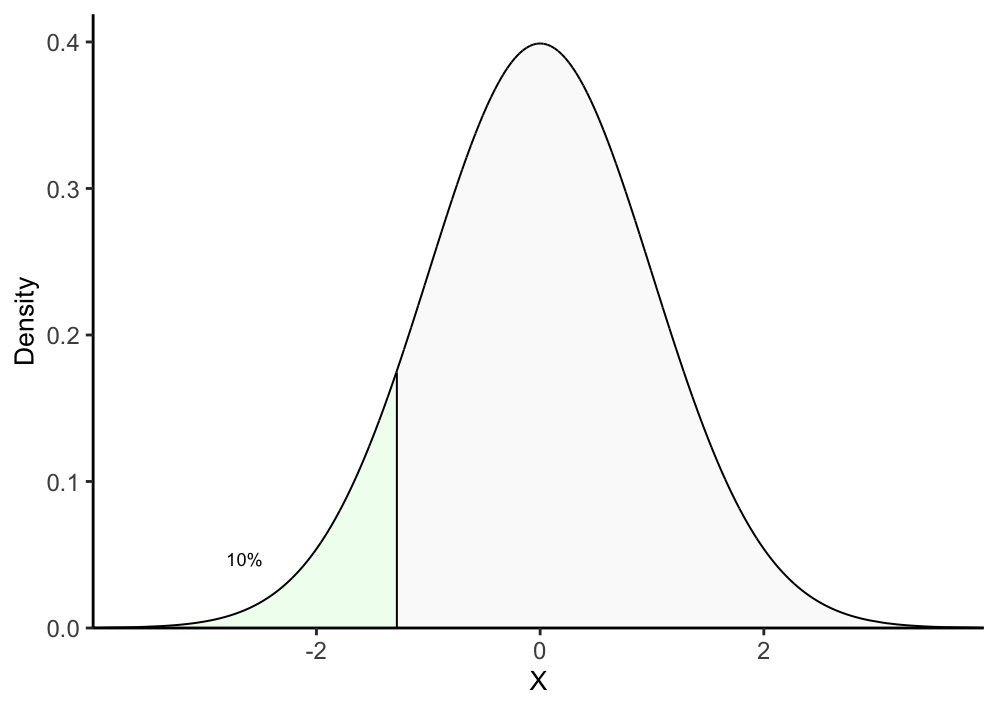
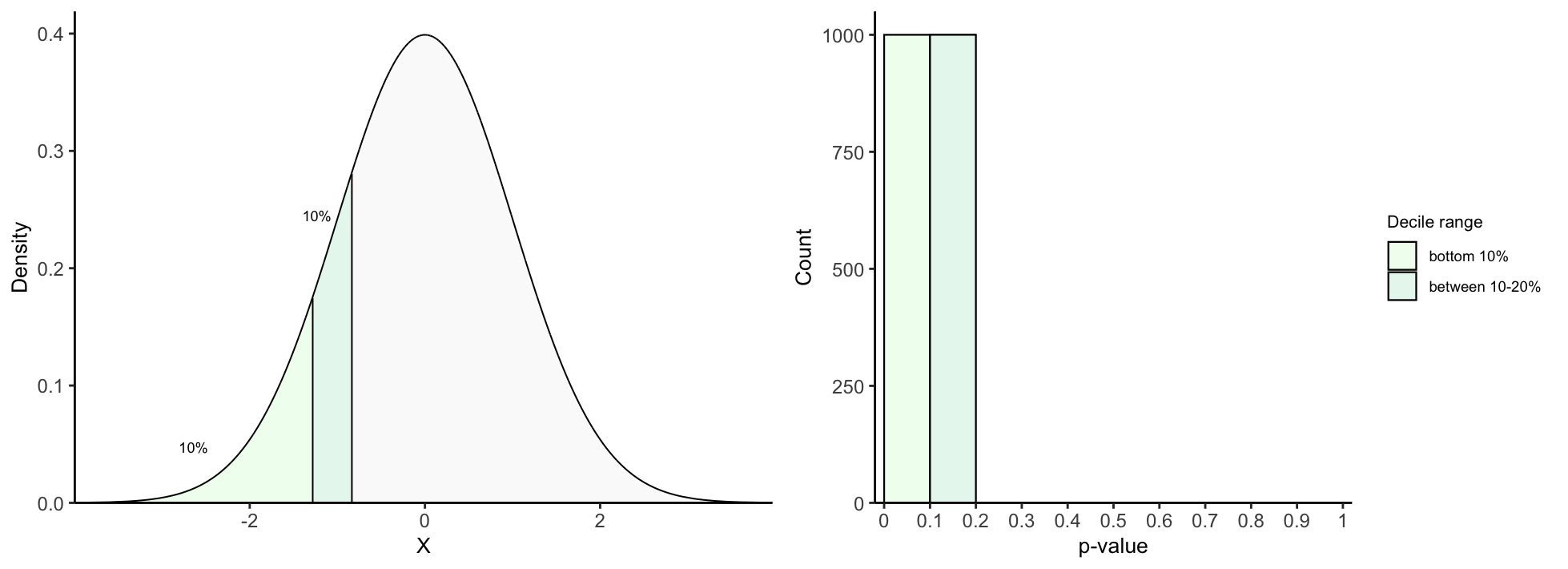
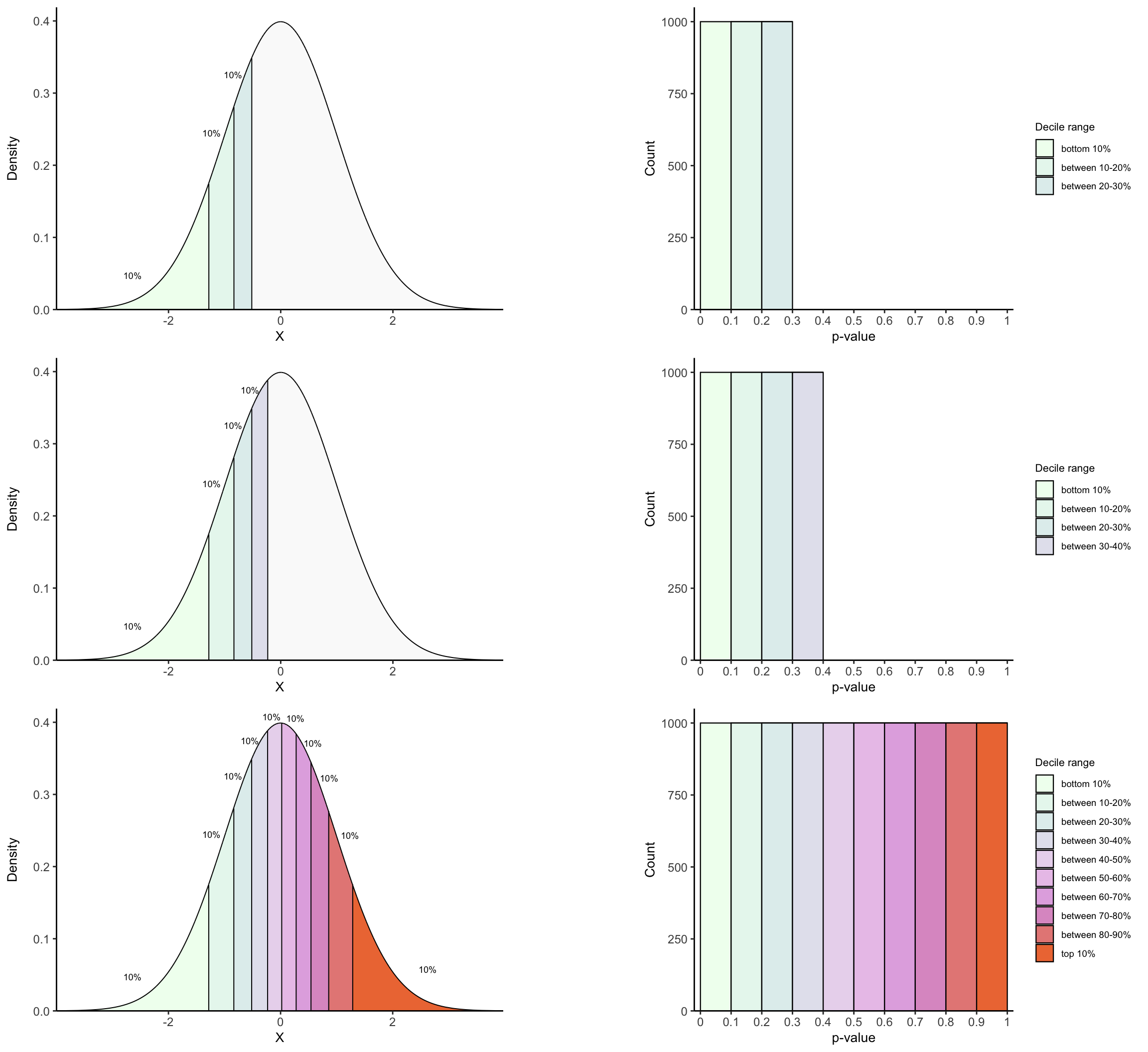
plot_density_decile <- function(decile){

  df <- annotate_decile_range(decile)

  ## Colors and alphas for decile ranges
  range_colors = c(colorRampPalette(c("honeydew1", "azure2", "thistle2","plum",
                                    "sienna2"))(10), "gray90")
  range_alphas = c(rep(1, 10), 0.2)
  names(range_colors) <- names(range_alphas) <- c("leq 0.1",
                                   paste("g", seq(from = 0.1, to = 0.9, by = 0.1), ",", "leq",
                                         seq(from = 0.1, to = 0.9, by = 0.1) + 0.1),
                                   paste("g", decile))

  vlines <- vector()
  for(q in seq(from = 0.1, to = decile, by = 0.1)){

    ## For vertical lines in each decile
    x = quantile(df$t, q)
    xend = quantile(df$t, q)
    y = 0
    yend = df[which.min(abs(df$t - x)), "y"]

    ## For annotating "10%" above each decile interval
    prior_x = quantile(df$t, q-0.1)
    prior_yend = df[which.min(abs(df$t - prior_x)), "y"]
    middle_x = prior_x + (x - prior_x)/2
    middle_y = prior_yend + (yend - prior_yend)/2

    if(q == 0.1){
      lab_x_pos = middle_x
      lab_y_pos = middle_y - 0.04
    }
    else if(q == 1){
      lab_x_pos = middle_x
      lab_y_pos = middle_y - 0.03
    }
    else if(q == 0.5){
      lab_x_pos = middle_x - 0.05
      lab_y_pos = middle_y + 0.014
    }
    else if(q == 0.6){
      lab_x_pos = middle_x + 0.12
      lab_y_pos = middle_y + 0.014
    }
    else{
      lab_x_pos = middle_x + (sign(x)*0.17)
      diff_y = abs((yend - prior_yend)/2)
      lab_y_pos = middle_y + (diff_y*0.33)
    }

    vlines <- rbind(vlines, c(q, x, xend, y, yend, lab_x_pos, lab_y_pos))
  }

  vlines <- as.data.frame(vlines)
  colnames(vlines) <- c("decile", "x", "xend", "y", "yend", "lab_x_pos", "lab_y_pos")


  plot <- ggplot(data = df, aes(x = t, ymin = 0, ymax = y,
                        fill = decile_range,
                        alpha = decile_range)) +
  geom_ribbon(color = "black", linewidth = 0.35) +
  theme_classic() +
  scale_fill_manual(values = range_colors) +
  scale_alpha_manual(values = range_alphas) +
  labs(x = "T",
       y = "Density") +
  geom_segment(data = vlines, inherit.aes = F,
               aes(x = x + 0.005,
                   xend = xend + 0.005,
                   y = y, yend = yend),
               linewidth = 0.35, show.legend = F) +
  geom_text(data = vlines, inherit.aes = F,
                aes(x = lab_x_pos, y = lab_y_pos), label ="10%",
            size = 2.4, show.legend = F) +
  guides(fill = "none", alpha = "none") +
  coord_cartesian(ylim = c(0, max(df$y)+0.02), expand = F) +
  theme(axis.text = element_text(size = 9),
        legend.text = element_text(size = 7),
        legend.title = element_text(size =8),
        legend.key.height = unit(0.5, "cm"),
        legend.key.width = unit(0.5, "cm"),
        axis.title.x = element_text(size = 10),
        axis.title.y = element_text(size = 10))

  ## To add labels for 1st and 2nd deciles
  if(decile == 0.1){
    plot <- plot + geom_text(aes(x = vlines[1,"x"], y = 0.015,
                                 label =  expression(t["10%"])),
                             inherit.aes = F, parse = T, size = 3.3)
  }
  else if(decile == 0.2){
    plot <- plot + geom_text(aes(x = vlines[1,"x"]-0.07, y = 0.015,
                                 label =  expression(t["10%"])),
                             inherit.aes = F, parse = T, size = 3.4) +
                   geom_text(aes(x = vlines[2,"x"]+0.07, y = 0.015,
                                 label =  expression(t["20%"])),
                             inherit.aes = F, parse = T, size = 3.4)
  }

  return(plot)
}


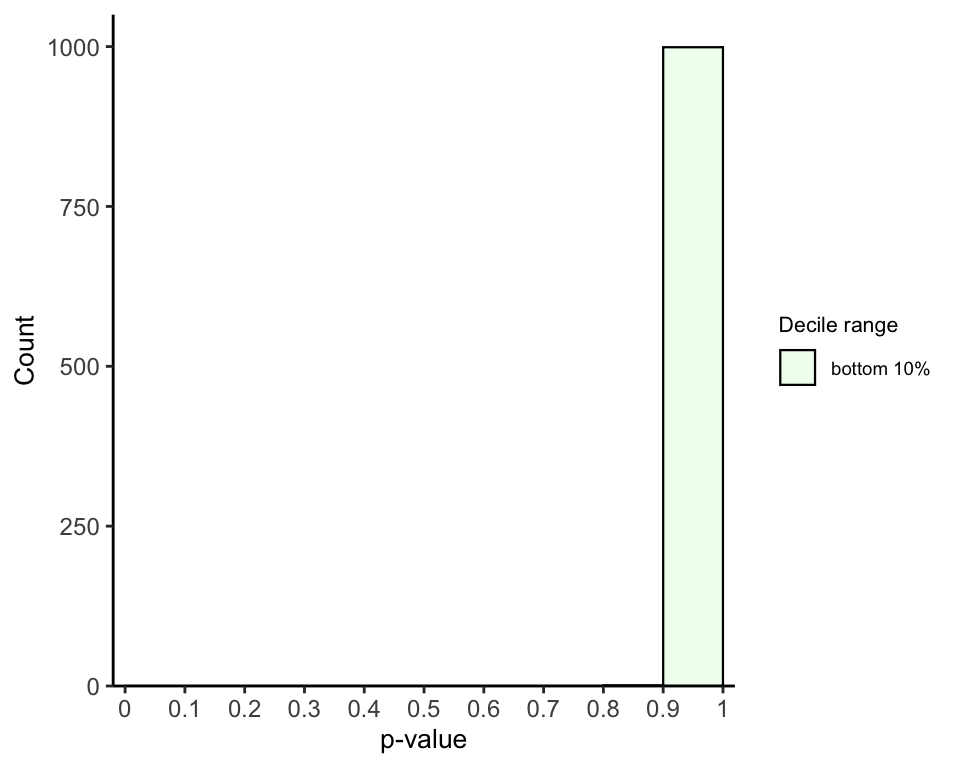
## 3. Function to plot pval histogram up to decile q
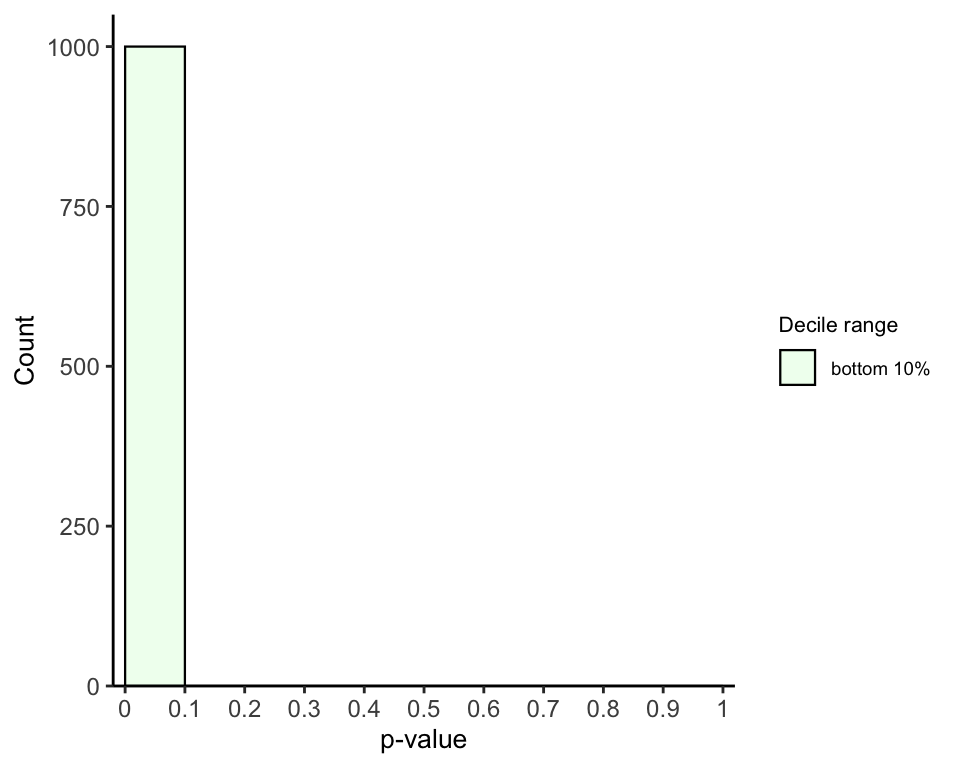
plot_pval_hist <- function(decile, tail){

  if(tail == "left"){
    tail_pvals <- "left_tailed_pval"
  } else if(tail == "right"){
    tail_pvals <- "right_tailed_pval"
  } else{
    tail_pvals <- "two_tailed_pval"
  }

  ## Colors and alphas for decile ranges
  range_colors = colorRampPalette(c("honeydew1", "azure2","thistle2","plum",
                                    "sienna2"))(10)
  names(range_colors) <- c("leq 0.1",
                                   paste("g", seq(from = 0.1, to = 0.9, by = 0.1), ",", "leq",
                                              seq(from = 0.1, to = 0.9, by = 0.1) + 0.1))

  decile_ranges_labs <- c("bottom 10%", "between 10-20%", "between 20-30%", "between 30-40%",
                          "between 40-50%", "between 50-60%", "between 60-70%",
                          "between 70-80%","between 80-90%", "top 10%")
  names(decile_ranges_labs) <- names(range_colors)

  df <- annotate_decile_range(decile)
  decile_ranges <- setdiff(unique(df$decile_range), paste("g", decile))

  data = subset(df, decile_range %in% decile_ranges)
  data$decile_range <- factor(data$decile_range, levels = names(decile_ranges_labs))

  if(tail == "both"){
    data$decile_range <- factor(data$decile_range, levels = rev(names(decile_ranges_labs)))
  }

  ## Histogram
  ggplot(data, aes(x = get(tail_pvals), fill = decile_range)) +
  geom_histogram(color="black", bins = 10, binwidth = 0.3, linewidth = 0.4,
                 breaks = seq(from = 0, to = 1, by = 0.1))  +
  theme_classic() +
  scale_fill_manual(values = range_colors, labels = decile_ranges_labs[decile_ranges]) +
  coord_cartesian(xlim = c(-0.02, 1.02), ylim = c(0, 1050), expand = F) +
  scale_x_continuous(breaks = seq(from = 0, to = 1, by = 0.1),
                     labels = seq(from = 0, to = 1, by = 0.1)) +
    labs(x = "p-value", y = "Count", fill = "Decile interval") +
    theme(axis.text = element_text(size = 9),
          legend.text = element_text(size = 7),
          legend.title = element_text(size =8),
          legend.key.height = unit(0.5, "cm"),
          legend.key.width = unit(0.5, "cm"),
          axis.title.x = element_text(size = 10),
          axis.title.y = element_text(size = 10))

}